

TL;DR
-
Spain beat Argentina in extra time on July 19 to win the 2026 World Cup, capping a tournament that broke US viewership records on both English- and Spanish-language coverage at nearly every stage, from the group round through the final.
-
The semifinals delivered the most-watched World Cup semifinal in English-language US history (16.9 million on Fox) — and for the first time ever, a majority of the Spanish-language semifinal audience watched via streaming rather than a traditional TV set.
-
FIFA is now asking for as much as $4 billion for the combined 2030/2034 US rights — roughly eight times what Fox paid for the 2018-2022-2026 package — with ESPN, Fox, and Netflix all signaling interest.
How big were the World Cup 2026 quarterfinal ratings?
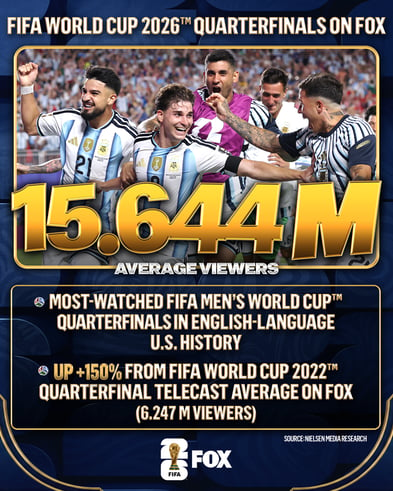
FOX Sports announced on July 15 that its English-language coverage averaged 15.64 million viewers across the four World Cup 2026 quarterfinal matches, calling it a continuation of a record-breaking run for the network.
The same day, NBCUniversal reported that Telemundo and Peacock's Spanish-language coverage averaged 10.4 million in Total Audience Delivery for the round — the most-watched quarterfinal stage in Spanish-language World Cup history.
Combined, English- and Spanish-language coverage averaged more than 26 million viewers per quarterfinal match— a record for the round, and a sign of how much ground this tournament covered across both audiences at once.
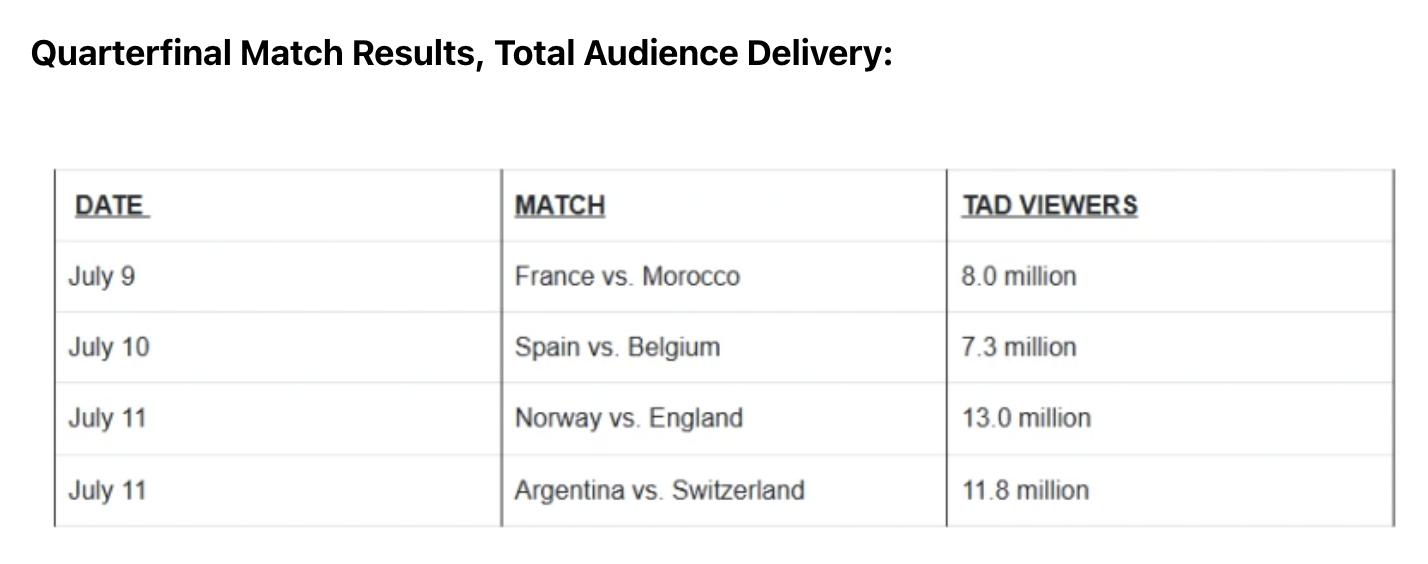
Match-by-match, the Spanish-language audience broke down like this, per Nielsen data reported by NewscastStudio:
- France vs. Morocco (July 9): 8 million
- Spain vs. Belgium (July 10): 7.3 million
- Norway vs. England (July 11): 13 million
- Argentina vs. Switzerland (July 11): 11.8 million
What set the Spanish-language broadcast apart?
The 10.4 million quarterfinal average is up 154% from the equivalent round in 2022, when Telemundo and Peacock averaged 4.1 million.
Argentina's win over Switzerland became the most-watched Argentina soccer match in Spanish-language media history, 11% above the previous record of 10.6 million set against Cape Verde earlier in the tournament.
Telemundo also ranked first among Spanish-language television networks in total-day viewership for 30 consecutive matchdays, holding a 76% share among the measured networks.
The growth wasn't evenly split between linear and digital.
Linear coverage averaged 4.9 million viewers during match windows, up 80% from 2022. The digital average minute audience across Peacock and Telemundo's streaming platforms reached 5.5 million, up 302% from 1.4 million in 2022.
This means that streaming grew nearly four times faster than linear did.
The semifinals set the record. The final closed it out.
Fox's English-language semifinal coverage averaged 15.09 million viewers — up 131% from the 2022 semifinals in Qatar (6.53 million), which aired during winter months.
The July 16 Argentina-England match drew 16.90 million, the most-watched World Cup semifinal ever on English-language US television, peaking at 24.72 million viewers in the 4:45 p.m. ET quarter-hour.
Telemundo and Peacock's Spanish-language coverage combined for 10.6 million during the semifinal round, up 136% from 2022. Telemundo's linear audience rose 69% to 4.9 million. Peacock's streaming audience, tracked by Adobe Analytics, more than tripled — from 1.6 million in 2022 to 5.7 million.
Spain beat Argentina in extra time on July 19 to win the tournament.
Why is streaming carrying so much of the load?
The digital growth numbers point to something more structural than a good tournament.
Peacock and Telemundo's streaming platforms didn't function as a backup feed for people without cable — they were built and marketed as a first-class way to watch, running simultaneously with linear coverage rather than behind it.
That's a different model than simulcasting as an afterthought, and the numbers above are the proof it worked.
For the first time, streaming won the semifinal
For the first time in a men's World Cup, a majority of the Spanish-language semifinal audience watched on a streaming platform rather than a traditional TV set.
That's a tipping point.
Four years ago, Peacock's semifinal streaming audience was 1.6 million against Telemundo's linear audience of roughly 2.9 million. This year, streaming (5.7 million) outpaced linear (4.9 million) outright.
If you've been treating your stream as the overflow option for people who can't get to the TV, this is the data point that says to stop. The audience isn't waiting for you to catch up to streaming — for a lot of them, streaming is already the default.
What does this mean for streamers?
Real stakes beat manufactured hooks
The stakes came from inside the competition, not from a broadcaster hoping the right team would advance.
- Messi playing what may be his last World Cup.
- England chasing a first title since 1966.
- Argentina defending the trophy it won in 2022.
- Spain looking for its second-ever title.
None of that had to be manufactured — it was already there, and the numbers followed.
If your live-streaming strategy leans on an artificial hook — a giveaway, a big-name guest, some external reason to tune in — this is worth sitting with: strong, well-distributed live content with real stakes pulls a crowd on its own terms.
Multi-platform distribution is essential
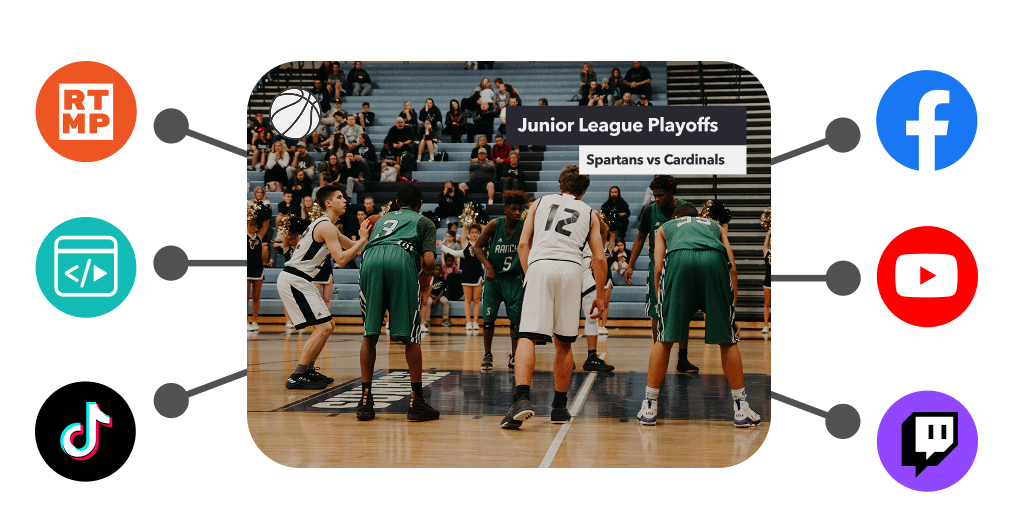
Multi-platform distribution is the baseline now, not the differentiator — at FIFA's scale, at least.
If you're running a single stream with a skeleton crew, that doesn't mean matching NBCUniversal's infrastructure; it means picking the one or two additional platforms your actual audience already uses and showing up there consistently, rather than treating your main channel as the only one that counts.
Advertisers care about more than reach
NBCUniversal's brand research found a:
- 33% increase in message memorability
- 46% increase in the likelihood viewers would search for an advertised brand
- 20% increase in purchase intent compared with the 2022 tournament
Whether you have 10 million viewers or 1,000, that's the kind of engagement data sponsors use to decide whether a live audience is worth backing.
What's next
The tournament's numbers are already reshaping the next decade of World Cup broadcasting
FIFA is preparing to seek as much as $4 billion for the combined US media rights to 2030 and 2034, according to the Wall Street Journal — an eight-fold jump from the roughly $485 million Fox paid for the 2018, 2022, and 2026 tournaments combined.
FIFA reportedly plans to bundle the two tournaments into a single package, committing whoever wins to two consecutive cycles.
The field is more competitive than it's been in years
Fox has said it "absolutely" wants to rebid. ESPN chairman Jimmy Pitaro confirmed the network's interest publicly at the CNBC Sport x Boardroom Game Plan Summit on July 17, praising Fox's 2026 coverage before signaling ESPN wants back in after carrying the tournament from 1994 to 2014. Netflix, which already holds exclusive US rights to the 2027 and 2031 Women's World Cups, has signaled interest in the men's tournament too.
There's also a real chance the tournament itself changes shape
The Athletic has reported FIFA may expand the 2030 field from 48 to 64 teams, which would create enough broadcast inventory to split between two rights holders — most likely one linear network and one streamer — rather than concentrating it all with a single partner.
Two factors could cool the bidding, though
The 2030 tournament (Morocco, Spain, and Portugal) and 2034 tournament (Saudi Arabia) both land in time zones far less favorable to US audiences than this summer's North American slate.
Any bidder committing billions to FIFA will be doing it while also weighing the NFL's own upcoming rights renegotiation — a competing claim on the same money.
The throughline
2026 proved a World Cup can draw audiences that rival the NFL on a random weekday afternoon, and that streaming can carry more than half of a Spanish-language broadcast.
Four years from now, the platforms carrying that audience will likely look nothing like they do today.